The shift matters more than most people realize. When your financial data is always current, decisions that used to take days or weeks can be made in minutes. That speed changes how businesses operate, how investors read companies, and increasingly, how individuals manage their own money.
What Real-Time Financial Reporting Actually Means
Traditional financial reporting works in cycles – monthly, quarterly, or annually. You collect data over a period of time, reconcile it, run reports, and review what happened. By the time the report lands on a desk, the underlying events it describes might be weeks old. The decisions made from that report are always based on history, not the present.
Real-time financial reporting means your financial data is updated continuously or near-continuously, as transactions happen. Rather than waiting for a monthly close, you can see your current cash position, revenue, expenses, and margins at any point during the day. Think of it as the difference between reading a weather report from last Tuesday versus looking out the window right now.
This is possible today because financial systems are increasingly connected. Payment processors, bank accounts, invoicing software, expense tracking tools, and accounting platforms can all talk to each other automatically. When a sale is processed or an expense is logged, that data flows into the reporting layer in near real-time rather than sitting in a queue until someone manually enters it.
How It Works in Practice
The infrastructure behind real-time reporting involves a few moving parts working together. APIs – connections between software systems – allow data to flow automatically from where it's generated to where it's reported. A point-of-sale system, for example, sends each transaction directly to the accounting platform as it happens rather than exporting a file at the end of the day.
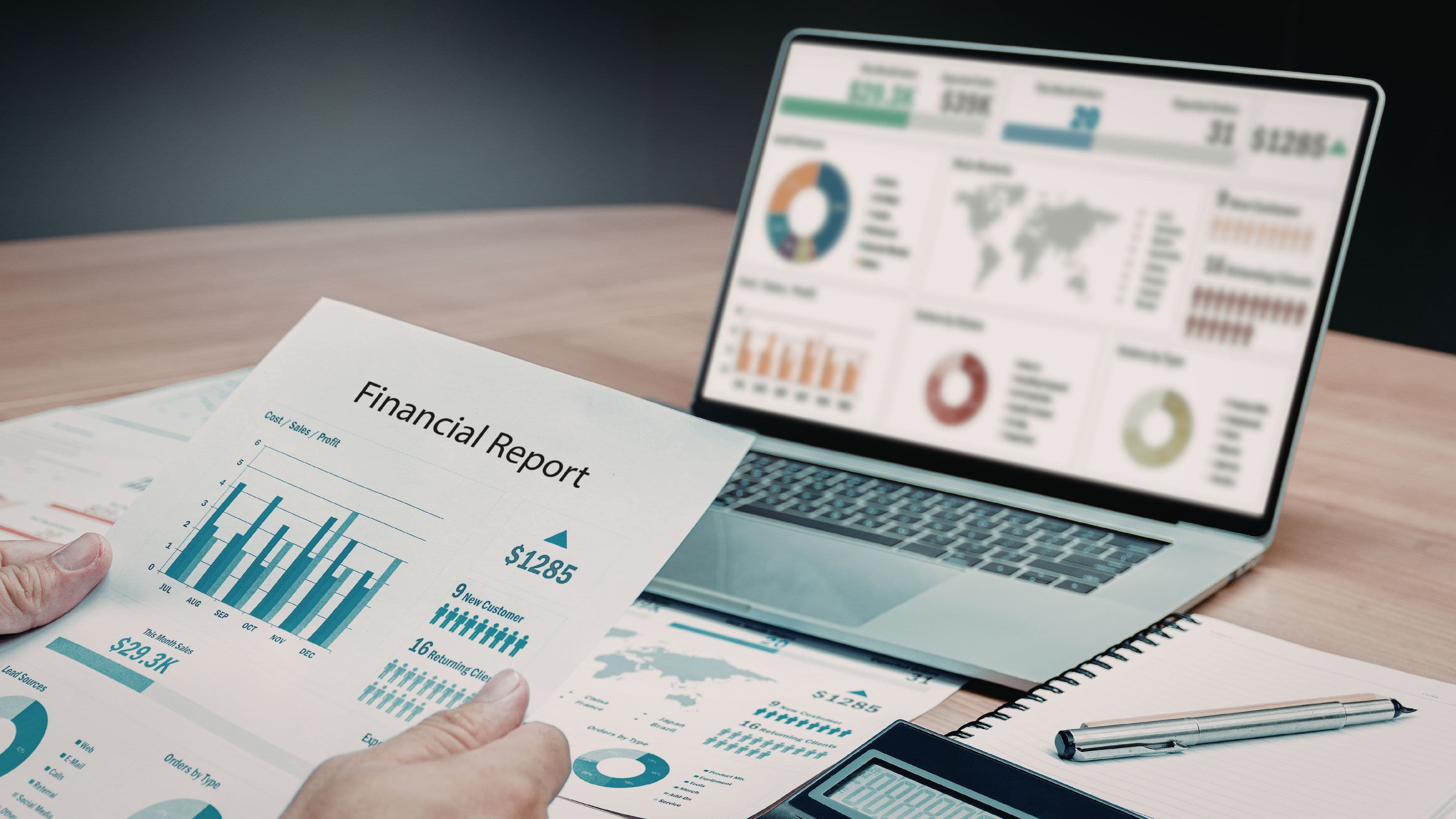
Cloud-based accounting software like QuickBooks Online, Xero, and Sage Intacct have made this kind of live data flow standard in business accounting. When you connect your bank account to one of these platforms, your transactions appear typically within hours rather than days, and the platform categorizes and reconciles them automatically. The result is a dashboard that reflects your actual financial position much more accurately than a spreadsheet updated once a week.
AI adds a meaningful layer on top of this. Machine learning systems can categorize transactions automatically, flag anomalies (an expense that looks unusual, a payment that came in twice), and generate narrative insights on top of the raw numbers. Instead of looking at a cash flow statement and doing your own interpretation, an AI-assisted reporting tool can tell you: "Your operating costs are up 12% this month compared to your 90-day average, driven primarily by software subscriptions." That interpretation layer is what turns data into actionable insight rather than just a number on a screen.
Who Benefits Most
Real-time financial reporting isn't equally valuable for everyone. The impact scales significantly based on how time-sensitive your financial decisions are and how much complexity you're managing.
Small Business Owners
For small business owners managing cash flow on tight margins, real-time visibility is genuinely transformative. Cash flow problems – not profitability issues – are the most common reason small businesses fail. Knowing in real time that your bank balance is dropping faster than incoming revenue allows you to act: delay a non-critical purchase, follow up on a late invoice, or draw on a line of credit before you're in a hole rather than after.
Traditionally, getting this kind of clarity meant waiting for an accountant to prepare a monthly report or spending hours manually pulling numbers together. With connected accounting software and real-time dashboards, a small business owner can check their current financial position in the same way they'd check their email – quickly, on their phone, without needing a finance background to interpret it.
Finance Teams at Mid-Sized Companies
For businesses with dedicated finance teams, real-time reporting compresses the monthly close process – the often painful end-of-month accounting sprint that consumes days of work reconciling transactions and preparing reports. When data flows continuously and reconciliation happens automatically, the close becomes an audit and review rather than a data entry exercise. Teams that used to spend a week on the monthly close can do it in a day or two, freeing time for higher-value analysis.
Real-time visibility also improves budget management. When department heads can see exactly where they stand against budget at any point in the month rather than finding out after the fact, overspending is caught earlier and decisions can be adjusted in time to matter.
Investors and Analysts
Public companies are required to report quarterly – a schedule built around the limits of traditional reporting, not the needs of investors. As real-time reporting infrastructure becomes more capable, there's growing discussion about the possibility of continuous disclosure: companies sharing financial metrics on an ongoing basis rather than in quarterly snapshots.
Even now, investors who use platforms that aggregate real-time financial data – transaction volumes, payment processing metrics, earnings estimate trackers – have a more current picture of a company's performance than what the official quarterly report provides. In market terms, more current data means better-informed decisions, and that's always valuable.
Individuals Managing Personal Finances
At the consumer level, real-time financial reporting is already the norm for many people without them necessarily calling it that. Apps like Mint, YNAB, and Copilot connect to bank accounts and credit cards and update spending categories in near real-time. You can see your monthly spending against budget at any point during the month rather than reviewing a credit card statement after the billing cycle closes.
This is the same principle as enterprise reporting, just applied to a household. Seeing that you've already spent 80% of your dining budget by the 15th of the month is useful information if you have two weeks left. Seeing it on the 31st only tells you what happened.
The Real Limitations Worth Knowing
Real-time reporting is genuinely useful, but it comes with real limitations that are easy to overlook when the dashboards look impressive.
Speed can create false confidence. A report that updates continuously can still be wrong if the underlying data is incomplete or miscategorized. Transactions that are pending but not yet settled, invoices that haven't been sent, or liabilities that aren't captured in the system will produce a real-time snapshot that looks current but is missing meaningful information. Timeliness is not the same as accuracy.
Not all financial events are instantaneous. Payroll, depreciation, accruals, and adjusting journal entries don't happen in real time – they happen at specific points in the accounting cycle. Real-time reporting captures transactional data well but is less complete on the accrual-basis information that matters for a full picture of financial health.
Information overload is a real risk. More frequent data doesn't automatically produce better decisions. A business owner who checks their real-time dashboard ten times a day and reacts to every small fluctuation is not using the tool well. Real-time reporting is most useful as a monitoring tool – alerting you when something meaningful changes – rather than as a source of constant micro-decisions.
Data security considerations increase. The integrations that enable real-time reporting require connecting financial accounts to third-party software. That connectivity introduces security and privacy considerations. Any platform with access to live financial data needs to meet high security standards, and users should understand what data is being accessed, how it's stored, and what protections are in place.
What to Watch Next
The trajectory here points toward increasingly automated and AI-interpreted financial reporting. Several developments are already underway. Continuous accounting – where closing the books becomes an ongoing process rather than a monthly sprint – is being adopted by larger businesses and the tooling is trickling down to smaller ones. AI-generated financial narratives, where software explains what the numbers mean rather than just displaying them, are becoming a standard feature in platforms like Sage Intacct and Microsoft Dynamics.
For individuals, the evolution is toward more intelligent personal finance tools that don't just show you what you spent but identify patterns, flag anomalies, and surface actionable recommendations. The gap between how financial professionals use data and how individuals use it is narrowing, which has meaningful implications for financial literacy and decision quality at scale.
FAQ
Is real-time financial reporting the same as live accounting? They're closely related but not identical. Real-time reporting refers to how current the data in your reports is. Live accounting – sometimes called continuous accounting – refers to the process of maintaining books on an ongoing basis rather than in monthly batches. Both rely on the same connected data infrastructure, and in practice they often go together.
Can small businesses actually afford real-time reporting tools? Yes. The barrier to entry has dropped significantly. Cloud accounting platforms like QuickBooks Online and Xero include real-time dashboards in their standard subscription tiers, which start at $15–$30/month. Personal finance apps like Copilot are around $8–$13/month. Enterprise-grade real-time reporting platforms cost more, but small and mid-sized businesses can get most of the practical benefit from accessible tools.
Does real-time reporting replace an accountant? No. Real-time reporting tools handle transactional data and basic categorization well. Accountants handle judgment-based work: tax strategy, complex reconciliations, audit preparation, financial planning, and the interpretation that matters for big decisions. The two are complementary – good real-time data makes an accountant's work faster and more useful, but it doesn't replace professional judgment.
How accurate is the automatic transaction categorization? It varies by platform and improves with use. Machine learning-based categorization learns from corrections over time and reaches reasonable accuracy for recurring, clearly labeled transactions. Unusual or ambiguous transactions still benefit from human review. Treating auto-categorization as a first draft that needs periodic spot-checking rather than a finished product produces the most reliable results.
What's the difference between real-time reporting and a live bank balance? Your bank balance is one number. Real-time financial reporting is a multi-dimensional view: revenue, expenses by category, margins, cash flow trends, budget comparisons, and more – all updated as transactions occur. A bank balance tells you what's in the account right now; real-time reporting tells you how you got there and where you're headed.
📚 Sources
QuickBooks – Real-Time Financial Reporting for Small Business: https://quickbooks.intuit.com/r/financial-management/real-time-financial-reporting/
Xero – Cloud Accounting and Live Financial Data: https://www.xero.com/us/accounting-software/
Sage – What Is Continuous Accounting?: https://www.sage.com/en-us/blog/what-is-continuous-accounting/
U.S. Securities and Exchange Commission – Financial Reporting Requirements: https://www.sec.gov/reportspubs/investor-publications/investorpubsbegfinstmtguidehtm.html
AICPA – The Future of Finance: Real-Time Reporting and AI: https://www.aicpa.org/resources/article/the-future-of-finance